Posts

Knowing the Sense Bases : The Great Six Sense - Media Discourse ( Maha Salayathanika Sutra MN)

Image
  Our samsaric journey is due to ignorance and craving ( avidya, tanha ) and therefore if we abandon ignorance and craving, we can end the samsaric journey or this endless cycle of rebirth. Samsaric journey entails a 'person’, one who hasn't seen the truth. In this journey a person faces so many hardships and suffer both physically and mentally, associating both good and bad people. Worldlings who are caught up in samsaric suffering tend to search for relief from that suffering, hence, they struggle to distance themselves from suffering and to enjoy happiness and mental relief. On the other hand, the wise person seeks the truth of life questioning what samsara is? what do we experience in this samsara? what is existence? what is the eye, what is the visible form, what are ear and sound, nose and odour, tongue and taste, body and feelings, mind and mental factors. Maha Salayathana sutta was preached by the Buddha to benefit those who are in search of the tru...
Discerning as against Logical Reasoning in understanding Buddha Dhamma

Image
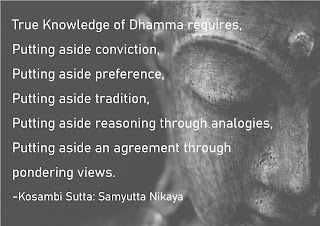
  It is said that the dhamma preached by the Buddha is  athakkavacara,  meaning beyond the scope of logic. Through logical reasoning one finds that he (or she) is right; Through discernment ( vicakshana ) one finds that he is wrong! Buddha Dhamma is about discerning  ( vicakshana )  and not about logical reasoning ( t arka ). Discerning and logical reasoning are two different things which contradict each other. We need to understand that first, i.e., what logic is and what discerning is. Discerning (of the dhamma) awaken  yonisomanasikara  known as the wise attention or more precisely, radical attention. Few other Pali terms with similar meanings are  upa parikshanaya  ,  parivimansana  and  patikucca vinita. "Why would logical reasoning become important? Isn't it to affirm that 'I' know what is right and to reaffirm that that 'I' am right? " Logical reasoning relies upon  sadda  (faith)  ruci  (p...

Faith & Pursuit of Liberation - Asivisopama Sutta (Samutta Nikaya)

Image
There is this person who wants to live not die, who desires to live happily and avert any pain. The man hears a voice, “listen good man, do you know that there are these four serpents, deadly & venomous, whom you have to nourish, feed them time to time, bathe and put to rest time to time? If any one of these venomous serpents is agitated, you will get bitten and meet with death or suffering similar to death, do what you want to do”, the voice said.  Startled by what he heard, the man  begins to run  aimlessly, to get away. The voice then says, “look good man there are five executioners who are also chasing right behind you, who would get to you any time and kill you. Do what you need to do!” The man afraid of the four venomous serpents, afraid of the five executioners, continues to flee. Listen good man, he hears the voice again, there is this sixth executioner, the one that is so intimate to you  with a raised sword above your head ,  who wants to take your...

Insight to Transcend the Worldly View Point: Bhadraka Sutta : Samyutta Nikaya

Image
  A Village headman by the name of Bhadraka Gamini approached Buddha one day and asked the Tathagata to teach him the origin of suffering (dukkha samudaya)) and its ending. 'If I preach you about arising of suffering and its ending with reference to the past and the future', said the Buddha, 'you will take it as applicable to the past or the future only , therefore, I will preach you the arising and the ending of suffering as it occurs in the present.' The Buddha asked him, 'Bhadraka, in Uruwela Kappa village, are there people about whom you will worry and be saddened if any harm come on them or they get imprisoned or die? Yes, my Lord there are some people in my village about whom I care for their wellbeing', replied Bhadraka. Then the Buddha asked him, 'are there people about whom you wouldn't be troubled and have any mental agony if they are met with death, harm or imprisonment', and Bhadraka answered, 'yes my Lord there are such people about ...

Penetrative Insight to Ending Dukkha, A Paradigm Shift - as Illuminated by Venerable Allawwe Anomadassi Thero.

Image
Teachings of Buddha primarily focus on knowing Dukkha(suffering) and ending Dukkha, by comprehending what Dukkha is, its cause, ending and the Path leading to end Dukkha.    Buddha’s approach to ending Dukkha or the Noble Path entered with the Right View called for a paradigm shift from the practices of the renowned teachers at the time like Alarakalama and Uddkaramaputta and the other seekers of the Truth, during and before his time. We come across some venerated Buddhist monks in the   present era who grasped this previously unseen radical approach of the sublime Teachings of the Buddha written   in the Sutra Pitaka of the Buddhist Cannon. Among them   are Venerable Nyanathiloka, Venerable Nyanaponika,   Venerable Nyanavimala Maha Theros form yester year and Venerable Denmarkaye Nyanadeepa and Ven Katukurunde Nyanananda Maha theros in recent times who had lived exemplary spiritual lives perfecting the three essentials of Buddhist tr...

Maha Yanna (Great Sacrifice) Sutta: Anguttara Nikaya 4

Image
Uggatasharira was a Brahmin who had planned to make a Great sacrifice (maha yañña) of the 500s (―500 bulls, 500 bullocks, 500 heifers, 500 goats, and 500 rams‖), but was given good advice by the Buddha on the true sacrifice.     Before lighting the inaugural fire and raising the flag post to conduct the Great Sacrifice which he thought was beneficial, the Brahmin visited the Buddha seeking his blessings. Having worshipped the Buddha the Brahmin reported the blessed one that he is about to light the inaugural fire and raise the flag post to begin the Yaga and inquired  if the Buddha agrees that such rituals are beneficial and has good consequences ( mahathpala mahanisansa ). The buddha agreed that such preparations will have worthy consequences provided they are done with good intentions. The Brahmins' intention was that conducting such sacrifice was a holy act, as done in the day, which was considered beneficial to the society and ...