Posts

Insight into Non-Self: A discussion Between Venerable Alawwe Anomadassi Thero and a Disciple

Image
  Understanding the Vision of Non-Self Question: Venerable sir, you've clarified that the phrase "N'etam mama, n'eso'ham asmi, n'eso me attā" ("This is not mine, I am not this, this is not myself") is not a personal assessment but a profound, direct vision of reality. This vision seems to be the very essence of abandoning the self ( sakkāya nirodha ). Is my understanding correct? Also, when we guide someone toward this truth, isn't it through this vision that the Dhamma is seen as profound ( athakkawachara ), leading to a state of complete loyalty and devotion ( anugatha ), rather than just intellectual reasoning? I tried to practice this, but I couldn't sustain the discernment, reverting to old habits. How can I sustain this practice? Answer: That's a perceptive question, and you've touched on a critical point. As long as we hold onto the notion of "self" or "I am" ( Pathavī ), any attempt to tran...

Beyond Self: Insights Into Buddhist Liberation

Image
  I am delighted to announce the publication of my new book, Beyond Self: Insights Into Buddhist Liberation. This book is a contemporary exploration of the Dhamma, and it’s a project that is very close to my heart. It contains edited content from many of the articles previously published here on the Dawn of The Truth blog, which were translated excerpts of Dhamma sermons by the Venerable Alawwe Anomadassi. For those of you who have followed the blog over the years, I hope this book serves as a valuable resource for your personal practice. Beyond Self can be ordered as a paperback or in eBook format from the link below: https://www.amazon.com/dp/ B0FJR5V4H7 With Metta!"

A Discussion Between Venerable Alawwe Anomadassi Thero and a Lay Disciple with Reference to Kamma Suttra.

Image
Question: Venerable Sir, when the eye is investigated truthfully according to the Dhamma, it cannot be found to exist, nor is there any apparent functionality of an “eye” that exists. However, an eye is always manifested in the world along with its functionality. Is this the basis for the Buddha’s statement in the Kamma Sutra, “Chakkun bhikkhave purana kammam”? Furthermore, when it is said that something is seen by the eye, it suggests the existence of a functional eye. Yet, in a true sense, such functionality cannot manifest according to the Dhamma. How should this be understood? Answer: Yes, that is the reason. When something is seen, or when we experience a sensation in the eye, it is referred to as arising (samudaya). This sensation can also be understood as a conditioned phenomenon—a result of one thing depending on another. On such grounds, we say there is a visual experience or a sensation in the eye. This sensation is prepared (abhisamkatham) and thought out or willed (abhi...

Brahmin Unnabha's Questions to the Buddha (Unnabha Brahmana Sutra)

Image
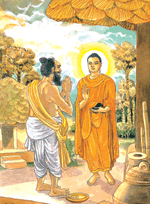
While he was residing at Savatthi the Brahman Unnaabha approached the Buddha  and after exchanging greetings and polite conversation were over, he sat down to one side and said to the Buddha; "There are these five sense faculties, good Gotama, of different spheres, different action, and they do not share in each other's sphere of action. Which five? The sense of sight, hearing, smelling, tasting and touching. As these five faculties are of different scope and range, and do not share in each other's sphere of action, what is their resort, and who profits from their combined activity?" "There are, Brahman, these five sense-faculties... which do not share in each other's sphere of action. Mind is their resort, and it is the mind that profits from their combined activity" the Buddha explained. It is evident from what the  Brahmin Unnabha raised here, his desire to find answers to the questions he faced through his inquiry into such salient Dhamma he had lear...

Knowing Consiousness

Image
  As we do not clearly know consioussness and its function as it is, we hold onto knowing something, something that we get to know, in other words we tend to associate a name form. It is the state of naming a form that we encounter, for e.g. as a thing with colour and shape.  However, if we endeavour to understand consioussness as it is, we need to focus on the process of consioussness. In the simile of the bicycle, for instance, we only see the movement of the bicycle rather than its actual function. We only observe its movement from one place to another but not its mechanism, i.e. how its rear wheel rotates with turning of the push pedals, causing its  movement.  Similarly, to understand the process of consioussness we need to focus on its function and not things that we get to know. How we comprehend consciousness as a process is the role of wisdom. On the other hand, if we focus on the name form, we are overlooking the actual process of consciousness ....

SELF & SELF VIEW

Image
The distinction between Self View (Sakkaya Ditti) and Self (Sakkaya) is known with wisdom. The delusive notion of permanent, pleasant and self nature in the world can be related to reflecting on a dream when one is awake taking such experiences as real. A person is able to reflect on a pleasurable experience of a dream for instance, while knowing that it was a dream and therefore without being attached. Similarly, when the notion of self is known, all worldly experiences become mere dreams to the wise person. With such wisdom, the person will not go along with worldly experiences interacting with persons or things, taking them as those that exist for real, beyond doubt.  If we consider the relationship between the Buddha and Devadatta for instance, as said in Sutras, we understand the extent of Buddha's compassion towards Devadatta. It doesn't mean that the Blessed one was ignorant about the monk and what people thought of him, yet he didn't even speak about his destiny in ...

Knowing the Sense Bases : The Great Six Sense - Media Discourse ( Maha Salayathanika Sutra MN)

Image
  Our samsaric journey is due to ignorance and craving ( avidya, tanha ) and therefore if we abandon ignorance and craving, we can end the samsaric journey or this endless cycle of rebirth. Samsaric journey entails a 'person’, one who hasn't seen the truth. In this journey a person faces so many hardships and suffer both physically and mentally, associating both good and bad people. Worldlings who are caught up in samsaric suffering tend to search for relief from that suffering, hence, they struggle to distance themselves from suffering and to enjoy happiness and mental relief. On the other hand, the wise person seeks the truth of life questioning what samsara is? what do we experience in this samsara? what is existence? what is the eye, what is the visible form, what are ear and sound, nose and odour, tongue and taste, body and feelings, mind and mental factors. Maha Salayathana sutta was preached by the Buddha to benefit those who are in search of the tru...